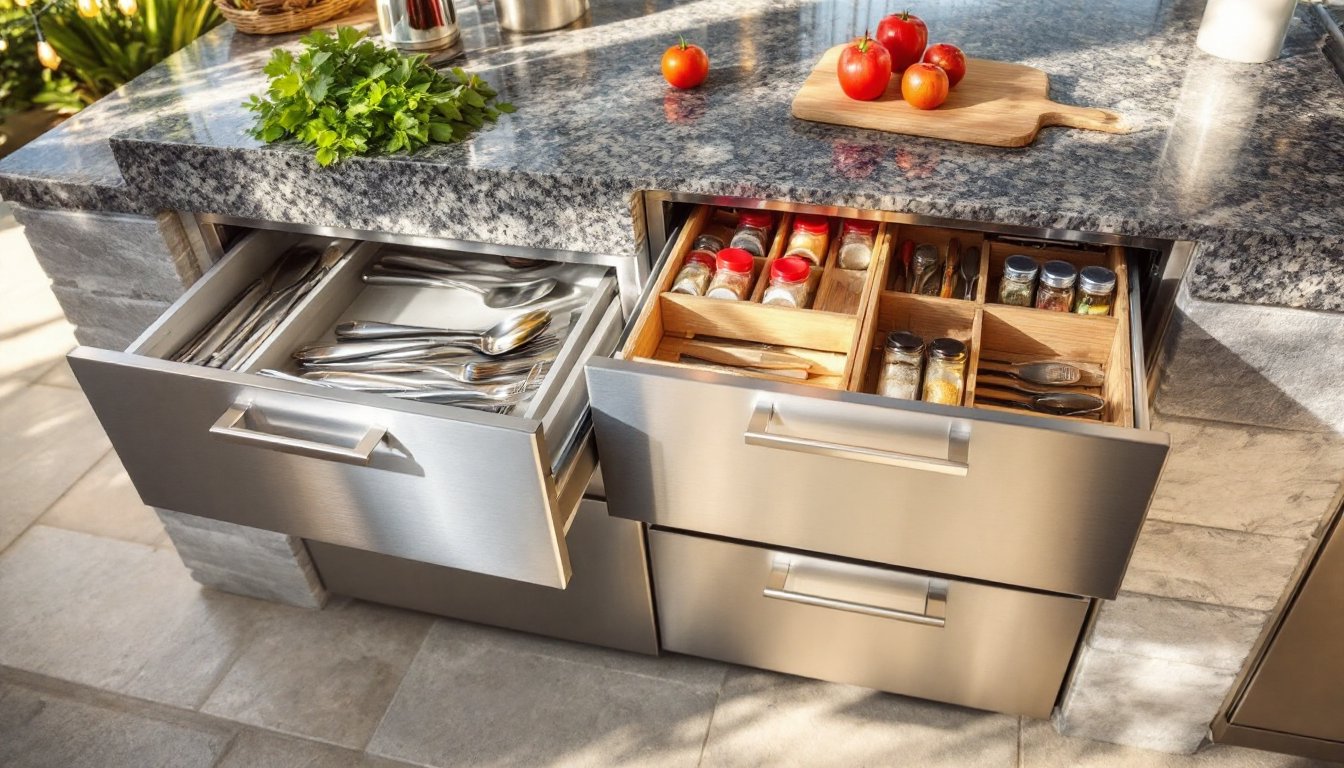
Outdoor kitchens have evolved far beyond a simple grill and folding table. Today’s setups demand the same functionality as their indoor counterparts, and that starts with smart storage. Outdoor kitchen drawers provide weatherproof, organized access to utensils, spices, tools, and supplies without constant trips inside. But not all drawers can handle UV exposure, temperature swings, and moisture. Choosing the right type, material, and installation method makes the difference between drawers that last a decade and ones that bind, rust, or warp by the second season.
Table of Contents
ToggleKey Takeaways
- Outdoor kitchen drawers provide weatherproof, organized storage for utensils, spices, and tools while protecting contents from humidity, UV exposure, and temperature swings that outdoor environments present.
- Marine-grade stainless steel (316 alloy) and HDPE polymer are the most durable materials for outdoor kitchen drawers, while wood should be avoided unless properly sealed with marine-grade epoxy.
- Gaskets, seals, drainage holes, and full-extension ball-bearing slides are essential design features that prevent moisture infiltration and extend the life of your outdoor kitchen drawers.
- Proper installation—including a level base, secure anchoring every 16 inches, and expansion gaps of 1/8 to 1/4 inch between modules—prevents binding and warping caused by temperature fluctuations.
- Outdoor kitchens with quality drawer storage systems can recoup up to 71% of their cost at resale and significantly improve functionality by keeping the cooking zone efficient and clutter-free.
- Load-test every drawer with realistic contents before use to identify binding or misalignment issues and ensure smooth operation under real-world cooking conditions.
Why Outdoor Kitchen Drawers Are Essential for Your Cooking Space
Outdoor kitchen drawers solve the biggest frustration of open-air cooking: accessibility. Without dedicated storage, grilling turns into a scavenger hunt, spatulas left on a side table, seasonings forgotten inside, trash bags stuffed under the grill.
Organized drawers keep everything within arm’s reach. A properly configured outdoor kitchen includes dedicated spots for utensils, spices, cleaning supplies, and trash bags, cutting down on movement and keeping the cook zone efficient.
Drawers also protect contents from the elements. Even covered patios expose items to humidity, pollen, insects, and temperature shifts. Marine-grade drawer systems with gaskets and seals keep moisture out and contents clean, extending the life of everything from tongs to thermometers.
They add significant resale value, too. Outdoor kitchens with built-in cabinetry and drawer systems are seen as permanent improvements, not temporary setups. According to the National Association of Realtors, outdoor kitchens can recoup 71% of their cost at resale, and quality storage is a key differentiator buyers notice.
Finally, drawers reduce clutter and improve safety. Open shelving invites wind-blown debris, spills, and pest intrusion. Drawers create enclosed, cleanable zones that meet the same sanitation expectations as indoor kitchens.
Types of Outdoor Kitchen Drawers and Their Best Uses
Utensil and Tool Drawers
Utensil drawers are typically 3–6 inches deep and fitted with removable divider trays. These keep spatulas, tongs, basting brushes, and grill forks separated and easy to grab mid-cook. Look for trays made from stainless steel or high-density polyethylene (HDPE), both resist warping and rinse clean.
Many installers position utensil drawers directly below the grill or prep counter at waist height for quick access. Standard widths run 18–24 inches to match cabinet modules.
Tool drawers go deeper, typically 8–12 inches, to accommodate bulkier items like meat thermometers, grill brushes, chimney starters, and spare igniters. These benefit from full-extension ball-bearing slides rated for at least 100 pounds, especially if storing cast-iron grill grates or heavy accessories.
Some tool drawers include pegboard inserts or adjustable partitions. This prevents items from sliding around and makes inventory visible at a glance. If the outdoor kitchen includes a smoker or pizza oven, dedicated tool storage for wood chunks, ash scoops, and peel paddles keeps specialized gear organized.
Spice and Condiment Drawers
Spice drawers are shallow, usually 2–4 inches deep, and designed to store bottles flat or upright in tiered racks. Outdoor conditions are tough on spices: heat accelerates flavor loss, and humidity causes clumping. A drawer with a weatherproof gasket and shaded location (not directly beside the grill) helps preserve quality.
Some outdoor cooks use drawer inserts with spring-loaded clips to secure bottles during drawer operation, preventing rattling and breakage. Stainless steel or bamboo inserts work well: avoid particleboard or MDF, which degrade outdoors.
Condiment drawers hold squeeze bottles, sauce containers, and oil cruets. These are often paired with a small cold drawer or cooler drawer insert to keep perishables like mayo or butter at safe temps. If installing a powered cooling drawer, ensure the unit is rated for outdoor use (typically IP55 or higher ingress protection) and wired to a GFCI-protected circuit per NEC Article 210.8.
Materials That Stand Up to the Elements
Stainless steel is the gold standard for outdoor kitchen drawers. Marine-grade 304 or 316 stainless steel resists rust, doesn’t off-gas, and tolerates temperature extremes from below freezing to over 120°F. The 316 alloy, with added molybdenum, performs better in coastal environments where salt air accelerates corrosion.
Stainless drawer boxes should have welded seams, not riveted or stapled joints, which can weaken over time. Look for drawer fronts with brushed or bead-blasted finishes, polished stainless shows fingerprints and water spots.
Marine-grade polymer (HDPE) cabinets and drawer boxes offer a budget-friendly alternative. These won’t rust, dent, or corrode, and they’re lighter than metal, reducing stress on slides. The downside: HDPE can become brittle after years of UV exposure unless treated with stabilizers. Check that the manufacturer specifies UV resistance and a minimum 10-year warranty.
Powder-coated aluminum is another option. It’s lightweight and corrosion-resistant, but the coating can chip if struck. Touch-up paint is necessary to prevent oxidation at exposed edges.
Avoid wood drawer boxes in outdoor kitchens unless they’re sealed with marine-grade epoxy and the climate is arid. Even treated wood absorbs moisture, leading to swelling, mold, and drawer bind. Exterior-grade plywood with waterproof glue (rated Exposure 1 or Exterior per PS 1-19) can work for cabinet carcasses if properly sealed, but stainless or polymer is still the smarter choice for drawer components.
Drawer slides matter as much as the box. Stainless steel ball-bearing slides with corrosion-resistant coatings (like zinc or ceramic) are essential. Undermount soft-close slides add convenience and reduce slamming, which can loosen hardware over time. Confirm the slides are rated for the drawer’s loaded weight, most quality slides handle 75–150 pounds.
Design Features That Make Outdoor Drawers More Functional
Gaskets and seals are non-negotiable for outdoor drawers. A silicone or EPDM rubber gasket around the drawer front creates a weathertight barrier, keeping out rain, dust, and insects. Without seals, moisture infiltrates and promotes rust or mold.
Drainage holes in the drawer bottom provide an escape route for any water that does get in, whether from washing or condensation. Holes should be at least 1/4 inch in diameter and positioned at the rear corners. Pair them with a sloped cabinet floor or weep holes in the cabinet kick plate to guide water out.
Locking mechanisms add security if the outdoor kitchen is in an unsupervised area or if storing expensive tools and gadgets. Keyed locks or push-button cam locks integrate cleanly into drawer fronts.
Soft-close dampers extend the life of both drawers and contents by preventing hard impacts. They’re especially useful for drawers holding glass bottles or delicate electronics like remote thermometers.
Pull-out trash and recycling drawers are a smart addition. These typically use a 35–50-quart bin on heavy-duty slides, with a lid that opens automatically as the drawer extends. Opt for bins with sealed lids to deter pests and odors.
Some higher-end systems include integrated LED lighting inside drawers, powered by low-voltage DC systems. These improve visibility during evening cookouts. Ensure any wiring is rated for wet locations and routed through weatherproof conduit.
Installation Tips for Maximum Durability and Convenience
Start with a level base. Outdoor kitchens are often built on concrete pads or pavers: even a 1/4-inch slope can cause drawers to drift open or bind. Use a 4-foot level and shim cabinets as needed. Stainless steel or plastic shims resist rot better than wood.
Anchor cabinets securely. For masonry surfaces, use stainless steel or galvanized concrete anchors (such as Tapcon screws or wedge anchors) driven into pre-drilled holes. For wood framing, use 3-inch exterior-grade screws into studs or blocking. Outdoor cabinetry faces wind loads and the weight of stone or tile countertops, so fastening every 16 inches along the back rail is standard practice.
Leave expansion gaps of 1/8 to 1/4 inch between cabinet modules. Temperature swings cause materials to expand and contract: without gaps, adjacent units can press together and bind drawers or crack panels.
Install drawer slides according to the manufacturer’s specs, ensuring they’re level and parallel. Most slides mount to the cabinet sides with the drawer box riding on ball-bearing carriages. Full-extension slides are worth the extra cost, they allow access to the entire drawer without reaching into a dark recess.
Apply a bead of marine-grade silicone sealant where the cabinet back meets the wall or structure, and along any seams where water could enter. Don’t seal the bottom: water needs an exit path.
If the outdoor kitchen includes electrical components (like lighting, outlets, or refrigeration), hire a licensed electrician for the wiring. Outdoor receptacles must be GFCI-protected and weatherproof (NEMA 3R-rated covers minimum), per NEC 210.8(A)(3). Drawers with powered features need appropriately rated cord and plug connections or hardwired junction boxes.
Finally, test every drawer under load before considering the job done. Load utensils, bottles, or weights matching real-world use, then open and close each drawer a dozen times. Adjust slide tension and check for binding or misalignment. This shakedown catches issues before the first cookout.